Constituency vs. Party-List: Translating Your Thailand 2026 Vote
February 06, 2026 04:00 AM
Last edited: February 03, 2026

by Thairanked Guide
Thairanked helps you discover great places in Thailand!
Search Hotels & Flights
Related Insights





Understanding Thailand’s 2026 Voting System: Constituency vs. Party-List
Thailand’s 2026 General Election is fast approaching, and with it, a familiar confusion for both expats and locals alike: how exactly does your vote translate into a seat in Parliament? The Thai electoral system, especially the mix of constituency and party-list seats, can seem complicated. But with the right explanations and examples, it’s easier than you might think.
The Dual-Ballot System: Two Votes, Two Ways
Thailand uses a mixed-member proportional representation system. Each eligible voter receives two ballots:
- Constituency Ballot: Vote for a candidate in your local electoral district.
- Party-List Ballot: Vote for the political party you support at a national level.
This dual-ballot approach aims to balance local representation with overall proportional fairness across the country. Let’s break down the difference and how your ballot impacts the formation of the House of Representatives.
Step 1: Constituency Voting Explained
Thailand is divided into multiple constituencies (usually based on population). Each constituency elects one Member of Parliament (MP), chosen by a first-past-the-post system, that is, the candidate with the most votes wins.
Example:
- Bangkok Constituency #5 has three candidates: A, B, and C.
- Results: A = 10,000 votes, B = 9,000 votes, C = 500 votes.
- Candidate A wins the seat for this constituency.
You can learn more about how the election cycle impacts daily life for expats in our guide: How the Election Will Reshape Tourism and Expat Life.
Step 2: Party-List Voting and Proportional Representation
The party-list vote is entirely separate from the candidate vote. Here’s how it works:
- You vote for a political party, not an individual.
- All party-list votes nationwide are counted together.
- Parties are then allocated a proportion of the 100 party-list seats based on their share of this national vote.
Example:
- Total party-list votes cast = 20,000,000.
- Party X gets 5,000,000 votes (25%).
- So, Party X should get around 25 party-list seats.
This party-list mechanism gives smaller parties a chance to be represented in Parliament, even if they can’t win in a specific constituency.
Step 3: Combining the Results, Seat Allocation Formula
Thailand’s system ultimately seeks ‘mixed-member proportionality.’ The total number of seats a party receives is influenced by both constituency and party-list results.
- Parliament size: 500 seats
- 400 seats from constituencies
- 100 seats from party-list
After constituency seat winners are determined, the Election Commission uses a mathematical formula to ensure every party’s total number of MPs (constituency + party-list) aligns as closely as possible with its percentage of the national party-list vote.
Simple Calculation Example:
- Party Y wins 60 constituency seats and receives 15% of the nationwide party-list vote, meaning ideally, they ought to have 15% x 500 seats = 75 seats in total.
- They already have 60 constituency winners, so are given 15 party-list seats (75 – 60 = 15).
These calculations can get complex as various thresholds and rules apply, but this is the basic principle. Sometimes, parties that do exceptionally well in constituencies may receive zero party-list seats, and vice versa.
Invalid or Blank Ballots: What Happens to Them?
Thailand takes the issue of invalid or blank ballots seriously. When you cast your vote, here’s what can happen:
- Valid ballot: Clearly marks only one candidate or party in the proper space.
- Invalid ballot: Marks multiple choices, includes identifying messages, or is left blank.
Invalid and blank ballots are counted and announced, but they do not help or hurt any candidate or party, nor are they redistributed. They simply reduce the pool of valid voting totals, potentially affecting what percentages are used for seat calculation.
Read about who is eligible to vote and how to register if you’re unsure of your voter rights.
Common Misconceptions Debunked
- “If I don’t like the candidate, can I just vote for the party?” You must vote on both ballots, one for a district candidate, one for a party. Each ballot is counted separately.
- “Blank or invalid ballots help one side or another.” They don’t. They only reduce the total number of valid votes and can slightly alter percentages, but no one ‘wins’ from invalid ballots.
- “Constituency MPs always follow their party.” Not necessarily! While most are loyal, some MPs can change allegiances between elections (the so-called ‘cobra MPs’).
- “Small parties can’t get in.” The party-list system gives smaller parties a road to Parliament, even if they lack local support.
For more on electoral myths and the quirky side of Thai politics, see: 50 Key Political Terms Expats Should Know.
What Should Voters Do at the Polls?
Simple steps:
- Bring your ID.
- Take two ballots: one for your local constituency, one for the national party-list.
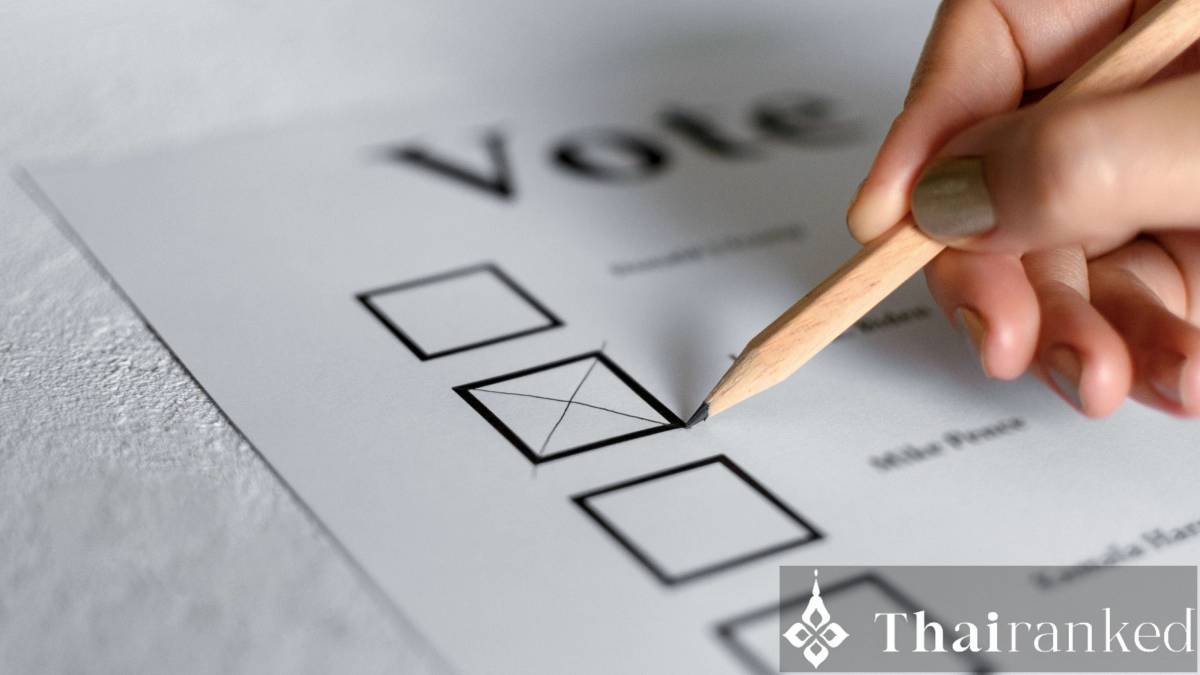
- Mark your choice clearly on each, no doodles, no stray marks, and no selfies in the booth!
- Drop each ballot into the correct box.
If you want to prepare for election day, catch up on the latest rules for alcohol bans and public holidays with our guide: Alcohol Ban on Election Day.
Why Understanding the System Matters
This dual system is part of Thailand’s efforts to combine the strengths of both individual and party representation, giving voice to all regions, parties large and small, and reflecting the will of the national electorate.
Staying informed about the process will ensure your vote counts as intended. With extra awareness, you can avoid invalid ballots and help make the 2026 election the most transparent yet.
Key takeaways
- Thailand’s election uses two ballots: one for local constituencies and one for national party-lists.
- Seats are assigned by both first-past-the-post (local) and nationwide proportional representation (party-list).
- Invalid/blank ballots are simply excluded from the count; they do not benefit any candidate.
- Every eligible voter should vote on both ballots to maximize their impact.
- Understanding the process avoids common mistakes that invalidate votes.
- Smaller parties can enter Parliament through the party-list system, even without constituency wins.
Search Hotels & Flights
Related Insights

Learn Thai business dining rules for 2026, how to behave at lunches and dinners, toast properly, handle the bill, and read sabai cues to win trust and respect.

Everything expats need to know about Thailand's alcohol sales ban on Visakha Bucha Day: timing, rules, exceptions, and practical survival tips.

Discover the unique national anthem tradition in Thailand, why everyone freezes in public at 8AM and 6PM, and tips on what to do if you’re caught by surprise.

Discover why Thailand enforces an alcohol ban on election days, how it prevents vote buying, and what travelers should know about this cultural law shock.

Discover tuition, housing, and living costs for students in Bangkok, Chiang Mai, Phuket, and more. Real budgets for Thai and international students in 2026.
What people ask about
"Constituency vs. Party-List: Translating Your Thailand 2026 Vote"
Here you will find answers to the most popular questions about Thailand.
 Chat with us